Training
Scientific computing and data science require special, practical skills in programming and computer use. However, these aren’t often learned in academic courses. This page is your portal for getting these skills. The focus is practical, hands-on courses for scientists, not theoretical academic courses.
Scientific Computing in Practice
SCIP is a lecture series at Aalto University which covers hands-on, practical scientific computing related topics. Lectures are open for the entire Aalto community as well as our partners around the world.
Examples of topics covered at different lectures: HPC crash course, Triton kickstarts, Linux Shell, Parallel programming models: MPI and OpenMP, GPU computing, Python for scientists, Data analysis with R and/or Python, Matlab and many others.
If you are interested in a re-run of our past courses or if you want to suggest a new course, please take this survey.
Upcoming at Aalto: AI in Research Work (Oct 22), AI agents unveiled (Oct 27), Starting computational research projects at Aalto (Oct 29), Open science and model cards in ML (Nov 3), Doing qualitative research in conversation with AI (Nov 10), Python for Scientific Computing (Nov 24–26). Upcoming at CSC / LUMI AI Factory: Practical Deep Learning (Oct 21–22), Agentic AI (Nov 3–5), Containers in Supercomputing Environment (Nov 24–26). Some of these workshops can give 1 ECTS: see SCI-L1010 Scientific Computing Skills for which events qualify and the requirements. More: CSC training calendar | RSE Seminar Series. Our SCI-L1010 course is now part of the doctoralcourses.fi network — doctoral students at partner Finnish universities can get credit for our courses (and CSC/LUMI training) more easily.
Upcoming Aalto courses and workshops
Oct 22, 2026, 9:30–15:30 AI in Research Work — generative AI in research workflows, ethics, and research integrity. LUMI AI Factory AI Hub, TUAS 4th floor, Espoo (morning hybrid, afternoon workshops in person only).
Oct 27, 2026, 13:00–14:30 AI agents unveiled: how AI agents work behind the scenes — how AI tools and agents work, good practices, and AI resources at Aalto. Hybrid: AI Hub TUAS + Zoom.
Oct 29, 2026, 13:00–14:30 Starting computational research projects at Aalto — good practices for data storage, code management, collaboration, and Aalto services. Hybrid: Otakaari 1, U523 Top Lounge + Zoom.
Nov 3, 2026, 13:00–14:30 Open science and model cards in machine learning — reading and writing model cards for reproducible ML research. Hybrid: AI Hub TUAS + Zoom.
Nov 10, 2026, 9:00–15:30 Doing qualitative research in conversation with AI — generative AI in qualitative and interpretive research: ethics, responsible conduct, and data security. Hybrid: AI Hub TUAS + online.
Nov 24–26, 2026 Python for Scientific Computing 2026 — NumPy, Pandas, Matplotlib and other scientific Python tools. Online, streamed via Twitch with CodeRefinery.
Upcoming CSC / LUMI AI Factory courses
Oct 21–22, 2026 Practical Deep Learning — neural networks (CNNs, RNNs, transformers) with PyTorch on the Roihu supercomputer. Hybrid: CSC, Keilaranta 14, Espoo + Zoom.
Nov 3–5, 2026 Agentic AI: Beyond Coding Assistants and Chatbots — building AI agents with Pydantic AI, from API calls to multi-agent systems. Online (setup session Nov 2).
Nov 24–26, 2026 Containers in Supercomputing Environment — building, running and deploying containers on supercomputers. Online, three half-day sessions.
Some of these workshops can give 1 ECTS: see SCI-L1010 Scientific Computing Skills for which events qualify and the requirements.
Anyone can sign up for announcements at the SCIP announcement mailinglist.
Our most important courses
These are the most important courses we recommend to new users:
These are other quite important courses we have developed:
Other interesting courses
Aalto Open Science team has courses on data management, reproducibility and open science:
Please check the following page for other courses at Aalto:
CSC has a portal for their training and courses:
MOOC courses on scientific computing:
Skills map
There is a lot to learn, and it all depends on each other. How do you get started?
Our training map Hands-on Scientific Computing sorts the skills you need by level and category, providing you a strategy to get started.
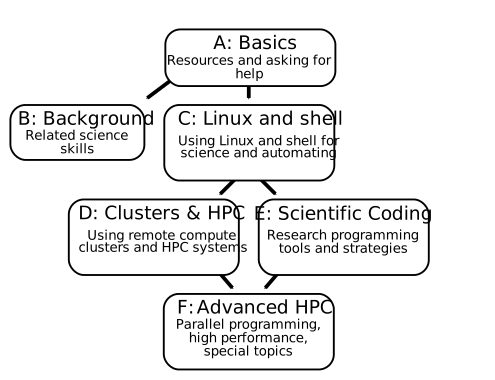
In order to do basic scientific computing, C (Linux and shell) is needed. To use a computer cluster, D (Clusters and HPC) is useful. E (scientific coding) is useful if you are writing your own software.